PARKSIDE
Office Building
Project Location: Tehran, Iran
Role: Lead Architectural Design | BIM Team Lead | BIM Coordinator | Real Estate Marketing & Branding
Project Status: Under Construction
Period of Contribution: 02/2023 – 01/2025
Client: Private Client
Credits & Ownership: Independent, Author-owned
—Portfolio Note:
This project represents original work and is shared here for portfolio purposes. Certain drawings and details have been selectively simplified, modified, or shown in non-final form.
—Project Overview:
Parkside is a six-story office building with a total built-up area of 3,500 square meters, located in a newly developed neighborhood west of Tehran, Iran. It received municipal approval ten years ago, but financing through pre-selling (common in the local real estate market) failed due to low investment appeal. The owner awarded a comprehensive Design + BIM contract to RENA Engineering & Construction Management. Under my role as Managing Director, we handled feasibility studies, initial sales programs, financing strategies, architectural design, and LOD 350 BIM modeling to revive and advance the project.


—Context & Technical challenges:
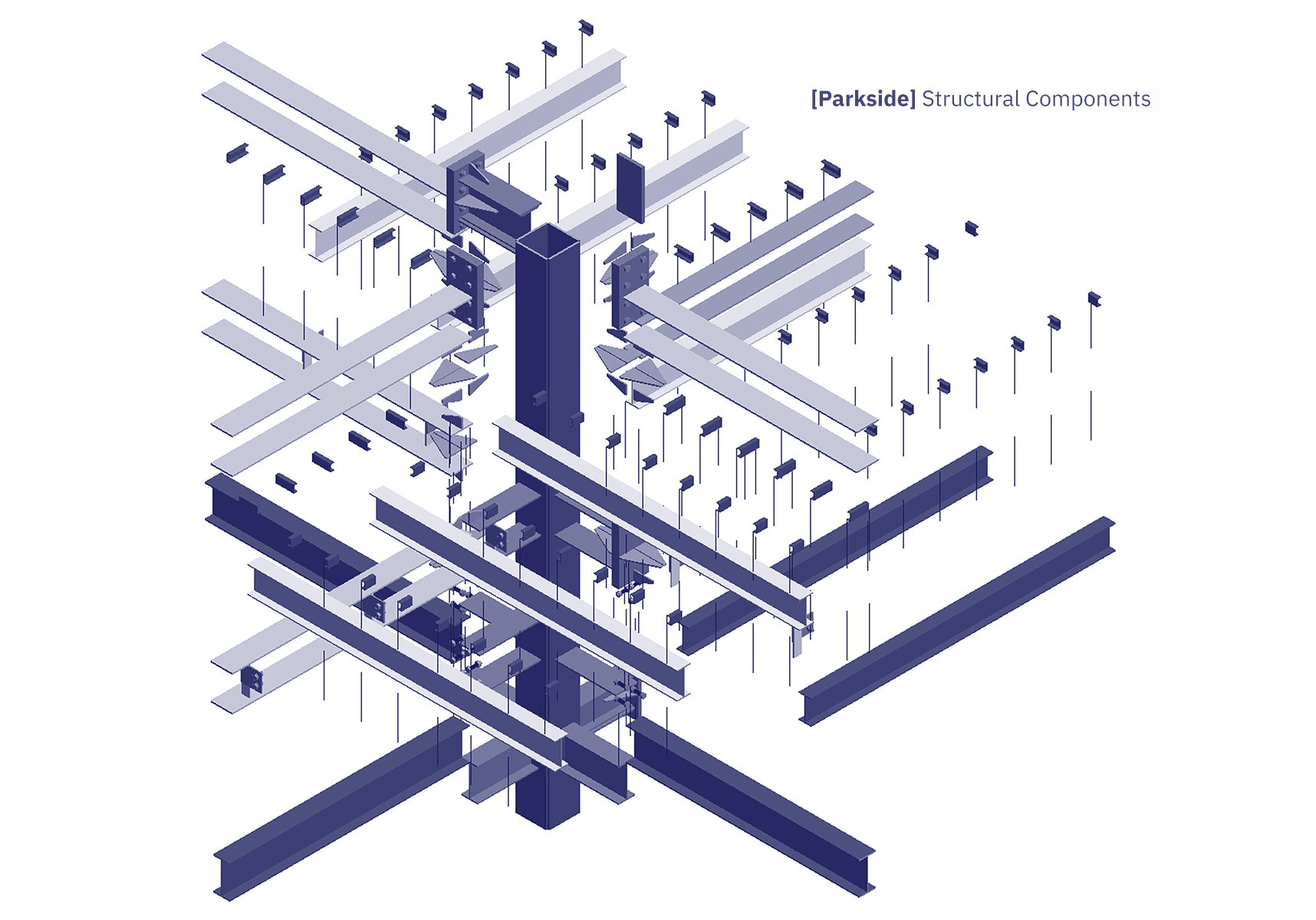
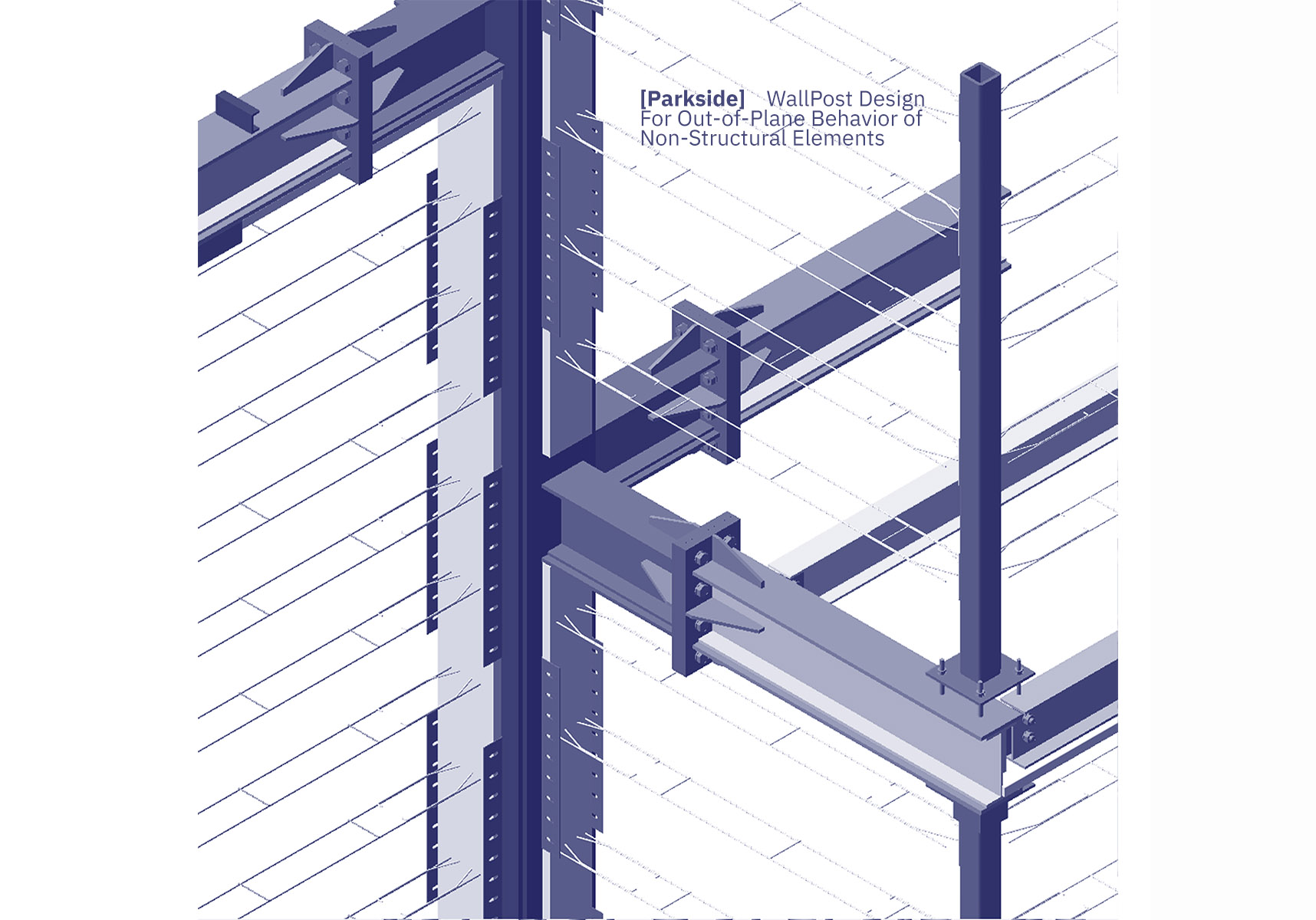
The structure was already designed cost-effectively, with partial development completed before the pause due to financing issues. Upon restart, the main organizational challenge was integrating a financial program with execution plans and tender documents, ensuring each stage’s costs aligned with pre-sale revenue needs. This made cost estimation and bill of quantities (BOQ) accuracy far more critical than in standard projects, further complicated by high inflation rates and economic instability. Technically, the challenge centered on Design + BIM integration under financial constraints: unlike typical workflows, financing relied on design precision, pre-sale on cost reliability, and costs on BIM accuracy. LOD 350 modeling was thus directly tied to financial sensitivity, demanding exceptional coordination for quantity take-offs, BOQ precision, and constructability validation.


—Role & Modelling Scope:
I served as CEO and Design + BIM Lead for the project, with a leadership-based role within a team structure. Functionally, I integrated feasibility studies, financing strategies, architectural design development, and LOD 350 BIM modeling. I directly led the architectural BIM process and supervised MEP modeling via a third-party contract, ensuring overall coordination, constructability, and alignment with financing goals. The team included three in-house architectural BIM modelers, a contracted MEP team, and structural engineers; while I was involved in technical modeling, my focus was on strategic coordination, quality control, and oversight. I interfaced with architecture (internal), MEP (external), structural engineers, cost/BOQ specialists, sales/financing stakeholders, and the owner. I was responsible for feasibility validation, architectural concept/development/execution, BIM coordination strategy (LOD 350), phasing for pre-sales, final approvals, and team management. I contributed to structural optimization, MEP decisions, and value engineering/cost strategies. Work was ultimately approved by the project owner/investor, especially on financial and major design aspects.


—Coordination & Collaboration:
The project began with our firm taking over the Design + BIM contract after the decade-long pause, starting with inputs like existing 2D CAD documents, municipal permits, initial concept 3D models, and reference materials. First tasks involved feasibility studies and architectural BIM modeling, progressing sequentially: validating financial strategies, refining architectural design, developing LOD 350 models, coordinating with MEP/structural disciplines, and preparing tender documents with BOQs. Coordination followed a federated model approach aligned with ISO 19650 principles (naming, versioning, information management) and a concise BIM Execution Plan (BEP) for responsibilities and exchanges, though not a full formal framework due to scale. Models from each discipline (Revit for architecture, Tekla for structure) were combined in Navisworks at milestones for clash detection and review. Changes stemmed from owner adjustments or cost considerations; conflicts were identified via automated Navisworks clashes, Revit visual inspections, and version controls, then resolved through internal evaluation, financial impact reassessment (Excel re-runs), owner consultations for major items, and updated model releases.


—Constraints & Responsibilities:
Key constraints included heavy financial limitations from pre-sale dependency, heightened cost accuracy needs per phase, inflation/economic volatility requiring ongoing validations, adherence to existing municipal approvals, and a limited team size demanding efficient workflows. Outside my responsibility: detailed structural engineering (pre-developed), MEP modeling execution (third-party), legal/contractual issues, final investment decisions, and site construction management. I relied on inputs from sales consultants for pre-sale validation, owner feedback on design/financing, structural engineers for system checks, and the MEP team for detailed models. Assumptions respected: maintaining financial feasibility for pre-sales, ensuring cost predictability in designs, avoiding fundamental changes to approvals, and keeping structural systems consistent with prior intent. Quality checks encompassed internal BIM checklists for naming/parameters, model-based quantity extractions with manual cross-checks on critical elements (e.g., concrete volumes, façade areas), milestone reviews, and embedded constructability validations to prevent budget risks.

—Deliverables & Outcome:
Primary outputs included feasibility studies with financing strategies, refined architectural designs, LOD 350 Revit models for architecture and MEP, coordinated federated models via Navisworks, precise BOQs and quantity take-offs exported to Excel, phasing logic for pre-sales, and tender/execution documents. These were used by the owner and investors for securing pre-sale financing, by construction teams for planning and procurement, and by stakeholders for validating cost reliability. The work clarified financial uncertainties by linking BIM accuracy to predictable costs, reducing risks of budget overruns or financing delays. It improved feasibility and decision-making through integrated design-BIM-finance workflows, enabling phased pre-sales based on validated constructability and minimizing deviations in an economically unstable context.


—Reflection & Key Learnings:
This was my first project with full leadership responsibility, emphasizing management and coordination over pure modeling despite the small scale. I applied structured BIM coordination principles and lightweight ISO 19650-inspired practices for information management, developing clear protocols for team communication, task distribution, and quality control to ensure model consistency. Leading the architectural BIM team and supervising external MEP modelers honed skills in technical reviews, conflict resolution, and validation under constraints. Key learnings included translating design intent into cost-reliable deliverables while balancing feasibility, gaining experience in financial-sensitive BIM outputs (e.g., elevated LOD 350 for BOQ precision), and handling interdisciplinary extensions into sales strategies. For a similar future project, I would implement a more formalized BEP from the start, integrate automated cost validation tools earlier, and allocate dedicated resources for inflation-adjusted financial modeling to further streamline decision-making and reduce coordination overhead.